
Having doubts? We will advise you on how to test your eyesight at home
You have never had a problem with your eyesight, but you feel that it is starting to change? Do you have trouble reading the number on an approaching bus or, conversely, can you focus on your mobile phone display only with difficulty? It may be a temporary but also a permanent phenomenon. After all, eyes age too...
In today's article you will learn:
- which eye defects or diseases may start to trouble you over time
- how to test your eyesight at home
- which eye diseases a home eyesight test cannot detect
It is natural for the quality of vision to change over the years
The eyes are an organ that ages just like other parts of our body. It is therefore entirely natural that the quality of our vision also changes with age. At the same time, however, it must be added that age is far from the only factor in deteriorating vision. It can also be affected by the working environment, lifestyle, past injuries or accidents, as well as other systemic diseases. All the more reason why we should not underestimate the symptoms of eye problems and should have regular eye check-ups.
We can start to experience vision problems at any stage of life. Some eye defects appear as early as childhood – especially short-sightedness or long-sightedness – while others are predominantly age-related and trouble us later, usually after the age of 40 (a typical example is age-related long-sightedness – presbyopia), or only in old age (for example, age-related macular degeneration or cataract). An insidious disease is glaucoma (gradual damage to the optic nerve), which can develop in our eyes for several years completely without symptoms.
You can find out at home whether your eyesight is deteriorating
There are several methods that allow you to find out at home whether your eyesight is deteriorating. However, it must be added straight away that a home test is only indicative and we do not recommend relying on it. Under no circumstances should you buy prescription glasses or contact lenses without first visiting an ophthalmologist. You will find out why below.Short-sightedness test
Does it seem to you that you see into the distance worse than you used to? Do you have trouble focusing on more distant objects? You are probably starting to develop short-sightedness. At home, you can test it, for example, with a Snellen chart. It has 11 rows; the largest letter is at the top of the “pyramid” and the smallest letters are in the bottom row. Next to each row there is a fraction that determines how well you see.
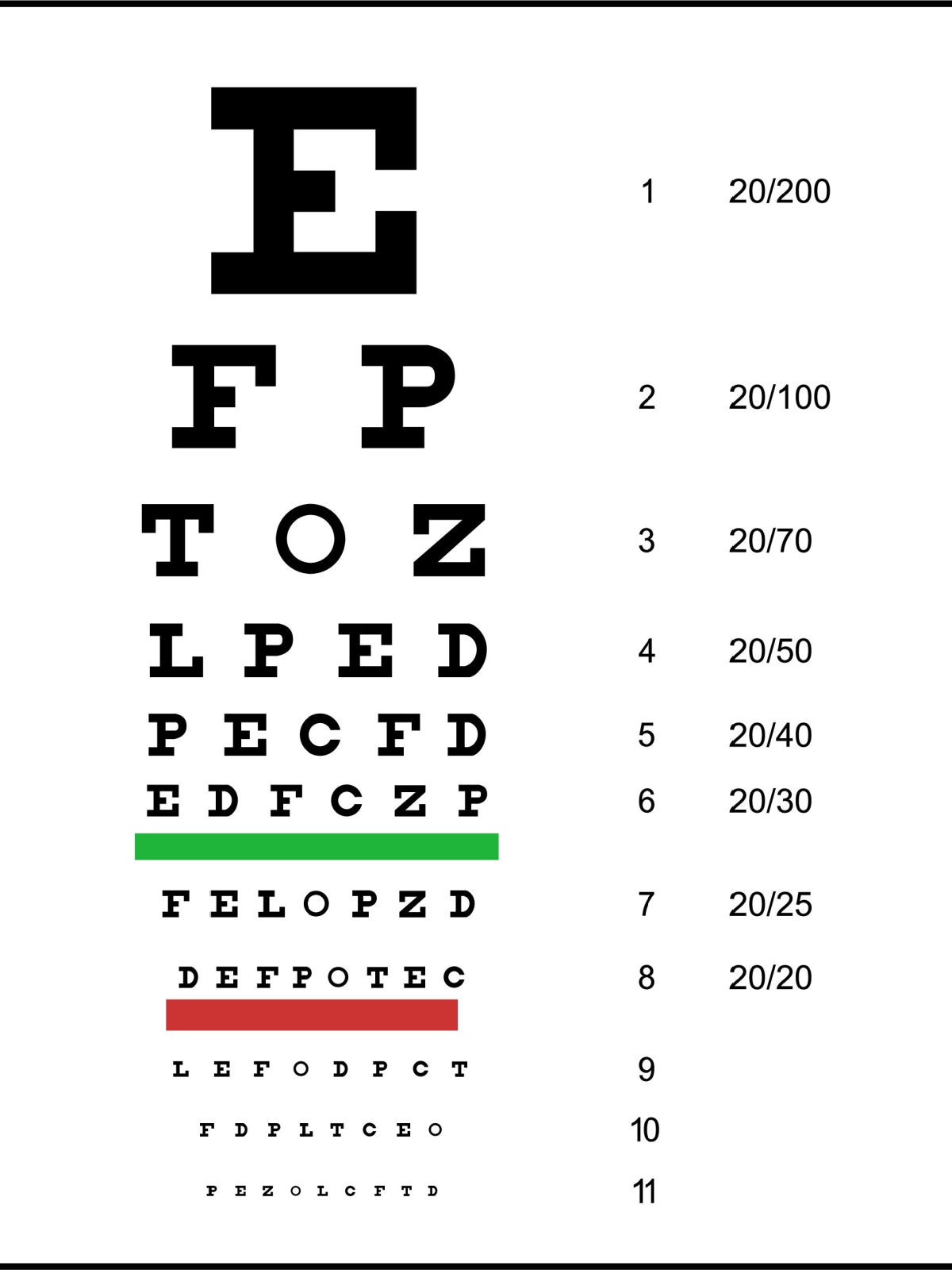
Get a chart, for example from the internet, and follow the seller's instructions. Larger formats (approx. 28 x 56 cm) are designed for measuring visual acuity from a distance of 6 m, but you can also order formats for a distance of 3 metres. Ideally, someone should assist you during the test to check whether you have read the letters correctly:
1. hang the chart on the wall
2. stand at the specified distance from the chart
3. cover one eye and read the letters from the top down, row by row
4. the last row you can read determines your visual acuity compared with people with good eyesight:
If you can read row no. 8 marked 20/20, you have good eyesight. The fraction means that from a distance of 20 feet (approx. 6 metres) you can read the row that people with good eyesight can also read from a distance of 20 feet. If you can read row 5 with the fraction 20/40, it means that from a distance of 6 metres you can read letters that people with good eyesight can read from a distance of 40 feet (12 metres).
This means that your eyesight is worse and you will need a corrective aid or eye surgery.
5. repeat the procedure with the other eye
Long-sightedness test
Similar charts can also be found on the internet for testing long-sightedness. Among the best known are charts with the letters “C” (in fact these are circles with a gap), which are arranged in rows. In the top row the symbols are the smallest, in the bottom row the largest. The symbols are in different positions (gap facing left, down, right, ...) and the aim is to determine their position. The chart can be printed in A4 format. Follow the instructions given in the user guide and you will find out whether you are starting to develop long-sightedness or presbyopia.

Colour blindness test
The ability to distinguish colours depends on 3 cones located in the retina of the eye. Each cone is responsible for seeing one primary colour (green, blue, red) and its shades. In colour blindness, most often one cone is missing; only in exceptional cases are all three missing. If this happens, the person sees only in black and white.
A colour blindness test can easily be done at home via the internet: search for an online colour perception test (for example, the Ishihara colour vision test) and follow the instructions. You will be looking for numbers or letters in a specific colour hidden in pictures made up of dots of different colours. If you can recognise them, you should not have a problem with colour blindness.

A professional eye examination is the only relevant way to identify a vision problem
Even though a home test may show you that your feeling of deteriorating eyesight was right, the real problem and the correct dioptres will only be revealed by an examination by an ophthalmologist. If you bought glasses without a professional examination, by choosing the wrong dioptres you would risk:
- further deterioration or more significant damage to your eyesight
- the risk of side effects – recurring headaches and eye pain, tiredness, red eyes, excessive watering of the eyes and the like
- reveal the reason for the eye defect or eye disease and determine the correct diagnosis
- determine the appropriate treatment – corrective aids or laser eye surgery
- detect a hidden eye disease and catch it at an early stage
- detect another serious disease that at first glance has nothing to do with the eyes – HIV, TB, multiple sclerosis or diabetes.
We are celebrating, and thanks to that you get your surgery at an extra advantageous price
After diagnosing your eye problem, the doctor will recommend a suitable surgical method to treat it. The most modern methods are characterised by painlessness, a minimal risk of post-operative complications and a short healing time. And it is precisely these that you can currently get with a discount of up to 50 %.
Thanks to you, our customers, we have become the winner of the fifth edition of the prestigious marketing programme “Dôveryhodné značky 2020” in the Eye Clinics category. On this occasion, we have decided to offer a 50 % discount on the ReLEx SMILE 3D, Z-Lasik Premium and Femto Z-Prelex methods to everyone who books one of the selected procedures by 31. 3. 2021, while the operation itself can be undergone until the end of June 2021. More information: https://www.iclinic.sk/operacia-dvoch-oci-za-cenu-jedneho.