
I have distance glasses. Do I have to wear them all the time?
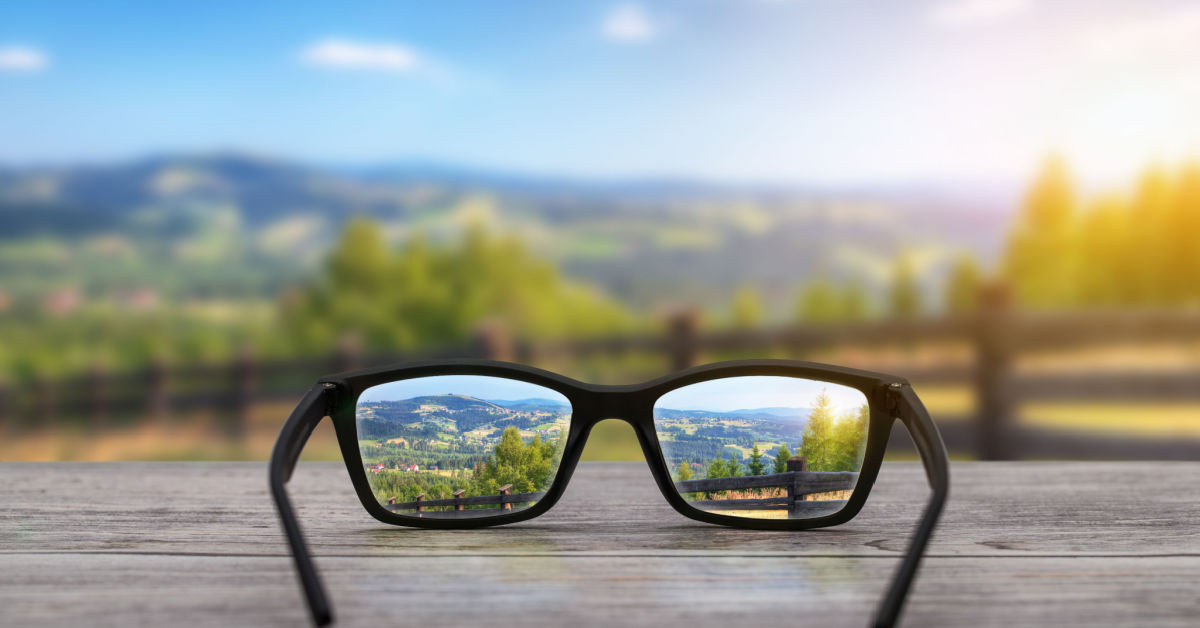
Has your distance vision got worse and you will have to wear glasses? It is a significant change in your everyday life, and getting used to prescription glasses is not always easy. On the other hand, only when you put them on will you find out how badly you have been seeing until now. You may have many questions in connection with this new development. One of the most common is: Do I have to wear distance glasses all the time?
You will find the answer not only to this question in this article.
Several factors can be responsible for short-sightedness
Short-sightedness, i.e. poor distance vision, is the most common refractive eye defect. In childhood, heredity plays the main part in its development. If eyesight deteriorates in adulthood, it is most often the result of a poor lifestyle, especially long hours at a computer, a tablet or in front of a mobile phone display. This factor is most dominant mainly in developed countries.Another problem is the ever lower age at which children start using a computer or a mobile phone. A lack of natural light and focusing mainly on very close objects mean that the ability to focus into the distance does not develop sufficiently, which results in short-sightedness.
For this reason, it is very important to take breaks at work, during which you should also exercise your eyes for distance vision, for example by looking out of the window. Ideally, however, you should spend as much time as possible in nature. Outdoors there are many stimuli that make us look and focus at various distances.
Another significant factor in the development of short-sightedness is other eye diseases and systemic diseases. Our distance vision can deteriorate, for example, with cataract, but also with diabetes or diabetic retinopathy.
What awaits you in life with glasses
Prescription glasses are the basic corrective aid for short-sightedness. Since the focal point in a short-sighted eye is shifted forward from the retina, the rays entering the eye do not converge on the retina but in front of it. For good vision, the focal point must therefore be shifted backwards, which is done by minus dioptres.If your eyesight has deteriorated so much that you will need it corrected, you should be prepared for several changes that await you. We can best describe them in the answers to the most frequently asked questions.
Do I have to wear distance glasses all the time?
Your doctor is the one to answer this question. It depends first of all on how badly your eyesight is impaired, and then on whether you suffer from any other problems that prescription glasses could worsen. In general, however, wearing distance glasses is recommended without any time limit. Your brain will quickly get used to the new state, and looking through the glasses both near and into the distance will become natural for it, and thus also for your eyes.Will glasses limit me in any way?
- Yes, glasses are a considerable limitation. Unfortunately, we could find really many situations that people without glasses do not have to deal with, but which will be problematic for you with glasses. Let us pick at least the most common ones:
- during sport
- when out in the sun – if you do not have glasses with protection against the sun's rays
- when watching a 3D film – regardless of whether in the cinema or at home, you need 3D glasses. And you will have to put them on over your prescription ones. You can probably imagine what it is like to wear two pairs of glasses... In this case, it is better to reach for contact lenses.
- with the whims of the weather – rain, for example, is a problem, and so is fogging up when going from the cold outdoors into a warm interior
- when you forget, lose or damage them – if you do not have an alternative with you, such as contact lenses, you have a problem. Driving without glasses, especially in reduced visibility, can be very dangerous.
Is there a big difference between ready-made glasses and custom-made glasses?
Consider glasses from a chemist's, a petrol station or a supermarket only as an emergency solution, for example if you forget or damage your prescription glasses. The difference between glasses with custom-made lenses and ready-made glasses is huge. Lenses made according to an ophthalmologist's prescription contain several precisely measured parameters based on the examination. Ready-made glasses are universal, and at most you can hit the right dioptre. With long-term use of ready-made glasses, besides further deterioration of your eyesight, you also risk greater fatigue, more frequent headaches or eye pain and similar undesirable conditions.Is it possible that I will not get used to glasses?
If you are an active person, glasses may indeed limit you too often. At the same time, besides distance glasses, around the age of 45 you will get another pair of glasses – for reading. Nobody can avoid presbyopia – the inability to focus on very close objects. The reason is the aged lens, which loses its elasticity. From this point of view, you will find it really hard to get used to glasses. But almost everyone gets used to wearing them as such. Some people even see prescription glasses as part of their image.Can I somehow avoid wearing glasses?
Yes, glasses are not the only way to correct eyesight. The first option is contact lenses. They are a direct competitor of prescription glasses. However, they do not cure your eyesight; they too only correct poor vision.From this point of view, the best alternative is laser eye surgery. Current methods are painless and performed on an outpatient basis, so you go home right after the procedure. At the same time, the most modern lasers are extremely precise, gentle to the eye, exceptionally accurate and delicate, thanks to which the healing time is short and the risk of post-operative complications minimal.
If you are not yet approaching forty, at our eye clinic you will probably be recommended one of the methods performed on the cornea. The absolute top methods include, for example, ReLEx SMILE 3D or Z-Lasik Z 3D. If you are over forty and presbyopia, or possibly cataract, is starting to appear, the ideal solution will be replacing your natural lens with a new one. If, besides presbyopia, you also have other vision problems, you can choose a multifocal lens, or even a trifocal one, which will free you from distance glasses, near glasses and reading glasses. In this case, we recommend finding out about the FEMTO Z-Prelex method, which is an improved version of the classic Prelex method.