

Dioptres – when our eyesight needs help
Probably everyone knows the term dioptre. In lay terms, most of us would probably answer the question “what are dioptres” by saying that they express a certain degree of vision problems. The higher the dioptres, the worse the eyesight. If they are minus, we see worse into the distance; if they are plus, we have a problem with vision at short distances. However, probably only a few people know what exactly dioptres mean from a professional point of view.

In this article you will learn what a dioptre is, how a dioptre prescription for glasses differs from a prescription for lenses, and also whether it is possible to calculate your dioptres without visiting an ophthalmologist.
What are dioptres?
A dioptre is the unit of the optical power of a spherical lens or a curved mirror. It is denoted by the abbreviations dpt or D and is most often used in optics. Optical power is defined as the reciprocal of the focal length. A lens whose focal length is one metre has an optical power of 1 dioptre.
At rest, a healthy human eye has an optical power of approximately 60 dioptres, which corresponds to a focal length of approximately 17 mm. Deviations from this value are expressed in minus or plus values. Simply put, the dioptre number determines the optical power that contact lenses or glasses must have for the eye to obtain a sharp image.
Dioptres in refractive errors of the eye
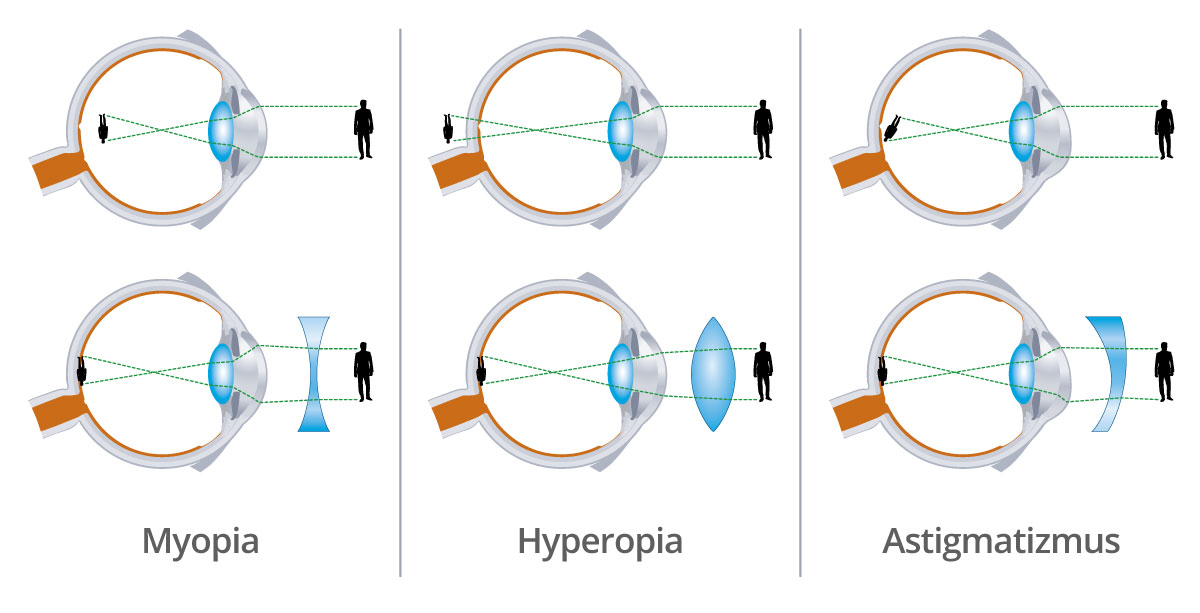
Refractive vision disorders such as short-sightedness, long-sightedness and astigmatism cause your eyes to have difficulty focusing light correctly. The size of the refractive error is given in dioptres. In long-sightedness they are marked with a minus sign (-) and in short-sightedness with a plus (+) or equals sign (=). In general, the further the number is from zero, the worse your eyesight and the greater the vision correction you need.
Minus dioptres
If the value of the dioptre is negative, the patient suffers from short-sightedness (myopia), i.e. they see well at short distances but cannot focus on distant objects. This is because the focal point is too far forward and must be shifted backwards. Concave contact lenses, which are curved inwards, or prescription glasses for distance are used for correction.
Plus dioptres
The opposite case are plus dioptres, which express the degree of long-sightedness (hypermetropia). A long-sighted person can focus into the distance without problems, but sees nearby objects around them blurred. In this case the focal point is shifted to the back, so the patient will have to get convex contact lenses or glasses for near vision.
A specific example is when a person starts to have problems focusing on near objects only after the age of 40. In that case it is most likely presbyopia, which affects everyone. This defect is corrected with reading glasses or laser eye surgery. It is the only option that can permanently solve the problem of presbyopia, but also of short-sightedness, long-sightedness or astigmatism.
Cylindrical dioptres
In astigmatism the degree of the refractive error is determined by cylindrical dioptres, the so-called cylinder and cylinder axis. The cylinder can be a negative or a positive number; the larger the number, the greater the refractive error. Besides the size of the dioptres, with this eye defect it is necessary to determine where the difference in curvature occurs. The orientation of the astigmatism is given by the cylinder axis, which is expressed in degrees from 0 to 180. In astigmatism, both values – the cylinder and the cylinder axis – are always stated.
A home eye test is not sufficient
If you feel that your eyesight has deteriorated, visit an ophthalmologist. Only a comprehensive eye examination can reveal the real problem. At the same time, an eye examination can also diagnose more serious diseases which at first glance do not concern vision. These include, for example, tuberculosis, multiple sclerosis or HIV.
If you nevertheless want to check your eyesight without visiting a doctor, you can use the Snellen chart. Probably everyone knows it from routine examinations at the general practitioner. The chart contains letters in rows; the largest letter is at the top of the chart and the smallest letters are arranged in the bottom row, number 11. Fractions are given next to each row. In the original (American) edition, the 8th row shows the fraction 20/20 and the letters are 8 mm high. If you can read that row from a distance of 6 metres, you have average eyesight.
The numbers in the fractions express the distance in feet (20 metres = 6 feet); in our country it is possible to obtain a chart in metres. In that case, row number eight is marked as 6/6. It means that you can read the given row from a distance of 6 metres, and a person with average eyesight likewise from six metres.
If you can clearly read, for example, row 5 with the fraction 6/12, it means that you have worse eyesight than an average person, since from 6 metres you see what they see from 12 metres. If you can read only the first seven rows, you will most likely need glasses. If, on the other hand, you can also read the lower rows, it means that you have above-average eyesight and you will not need glasses for distance.
You can also calculate, very roughly, the dioptres you will need. Determine a reference distance from which you would like to see a certain object. Let us say it will be two metres. Then move closer to the object until you see it quite clearly. You then calculate the necessary dioptres by subtracting the reference distance from the distance from which you saw the object. If you see the object, for example, from a distance of 0.5 metres, in order to see the object also from two metres you will probably need glasses with -1.5 dioptres. (0.5 m – 2 m = -1.5).
Do not buy contact lenses according to the dioptres prescribed for glasses
The difference in calculating the necessary dioptres when wearing glasses and contact lenses is that while the lenses are directly on the eyes, glasses are at a distance of approximately 12 mm from the eye. This affects the calculation especially at higher dioptres. At low dioptres it is possible to use the same values for glasses and lenses; at higher values (from approx. -4 or +4) it is necessary to calculate the dioptres separately for lenses and separately for glasses.In any case, we recommend consulting an ophthalmologist or optometrist at an eye optician’s. They will calculate the ideal dioptres for you separately for each eye, so that they are neither too weak nor unnecessarily strong – both for wearing glasses and for wearing contact lenses.